
Collection: Quartz Crystal

Quartz crystals are one of the most abundant crystals on earth. They are associated with motivation, protection, wisdom, and awareness. Many people look towards quartz for their soothing and cleansing energies. They also can be found in nearly every color.
We offer multiple products that feature Quartz crystal and may be found forms like tumbled and worry stones, clusters, pendulums, points and other carvings. We also have beautiful jewelry and décor pieces that’ll bring healing in your life! Read more about the quartz crystal meaning at the bottom of the page!
-
Quartz Animal Carvings
Regular price $17 - $80Regular priceUnit price per -
Black Tourmaline Quartz Chip Bracelet
Regular price $12.00Regular priceUnit price per -
Amethyst or Quartz Spike Bracelet
Regular price $45.00Regular priceUnit price per -
Stamped Sterling Silver Crystal Rings
Regular price $35.00Regular priceUnit price per -
Sterling Silver Rutile Quartz Rings
Regular price $33 - $36Regular priceUnit price per -
Sterling Silver Faceted Crystal Rings
Regular price $35.00Regular priceUnit price per -
Sterling Silver Lepidocrocite Rings
Regular price $66.00Regular priceUnit price per -
Agate Nightlight
Regular price $12.00Regular priceUnit price per -
 Sale
SaleRaw Stone Earrings
Regular price $9 - $13Regular priceUnit price per$14 - $18Sale price $9 - $13 Sale -
Rutilated Quartz Pendant
Regular price $14.00Regular priceUnit price per -
 Sold out
Silver Herkimer Diamond Ring
Regular price $58.00Regular priceUnit price per -
Black Tourmaline Quartz Bracelet
Regular price $18.00Regular priceUnit price per -
Silver Pakimer or Moonstone Necklace
Regular price $30.00Regular priceUnit price per -
Brazilian Crystal Pendants
Regular price $8.00Regular priceUnit price per -
Pakimer Diamond Earrings
Regular price $22.00Regular priceUnit price per -
Standing Crystal Cats
Regular price $18.00Regular priceUnit price per -
Agate Keychain
Regular price $10.00Regular priceUnit price per -
Quartz Keychain
Regular price $5.00Regular priceUnit price per -
Rutile Quartz Bracelet
Regular price $18.00Regular priceUnit price per -
Crystal Chip Ring
Regular price $6.00Regular priceUnit price per -
Crystal Chip Bracelets
Regular price $8.00Regular priceUnit price per -
Girasol Quartz Pendant
Regular price $33.00Regular priceUnit price per -
Crystal Pendulum
Regular price $8.00Regular priceUnit price per -
Quartz Point Cuff Bracelets
Regular price $16.00Regular priceUnit price per


Quartz is a group of minerals most commonly found in granite, sandstone, and shale. They are fomed by magma cooling down slowly. The main components in these crystals is silicon and oxygen which makes up the compound silicon dioxide. There are some other impurities in this gemstone such as lithium and titanium which result in specimens like Amethyst, Smoky Quartz, Citrine, Rose Quartz and much more. Numerous crystals like Agates and Jasper crystals also contain a network of Quartz.
Quartz is a silicon dioxide mineral. It’s particularly hard with a 7 on the Mohs scale. This crystal is also durable in high temperatures. The fracture is conchoidal when the mineral breaks.
Quartz’s name comes from the Polish word “kwardy” which means hard. This resembles the significant hardness of the stone.
Types Of Quartz
There are many types of quartz crystals that can vastly differ in terms of color, structure, and appearance, but they all share the same chemical composition (silicon dioxide). Citrine, amethyst, jasper, agate, and carnelian are all different types of quartz.

What does Quartz look like?

Quartz, arguably the most well-known crystal, is a crystalline mineral that ranges from from a transparent clear coloring to a solid milky white. Quartz can looks and feel like glass because of its nearly see-through appearance and incredibly smooth, almost flawless sides. They can often have internal cracks that cause rainbows or many other types of inclusions of other minerals.
Quartz is the most common mineral in the continental crust and is present in almost every rock and all three types (sedimentary, igneous, and metamorphic).
This mineral is so common that beach sand comprises large amounts of quartz; the whiter the sand, the higher the quartz content.
Quartz has a notable hexagonal structure of six flat sides and comes to either one point or can be pointed at both ends (it looks similar to a pencil). Quartz is most commonly found in “wands,” clusters, geodes, and as particles within other rocks.

Because it is so common, it can often have a wide variety of looks especially due to inclusions of other minerals and can take on nearly every shade from grays, to pinks, to yellows, to black and everything in between.
Despite the fact that quartz is one of the most common minerals found, it has been knocked-off as both lab grown and glass imitations. If it looks TOO perfect, like perfect points, perfect cluster formation as a 360, etc., or if there are tiny little bubbles (not to be confused with natural enhydro bubbles), it is likely fake. But this is nothing new, the first ‘home grown’ quartz was in the 1840’s haha. Still be careful.
Learn more about the quartz family of crystals, including how to differentiate between the stones on the blog post dedicated to that.
Difference Between Clear Quartz & White Quartz
Clear quartz and white quartz are both a part of the quartz family but differ in clarity, appearance, and formation. An easy rule to follow is that clear quartz is transparent or colorless whereas white quartz is opaque or transluscent white. Clear quartz also forms slowly over time, and white quartz forms faster. It should also be noted that white quartz is the most abundant type of quartz on the planet.

Difference Between Quartz and Citrine
Citrine is another quartz variety that ranges in color from pale yellow to a translucent brown. The color of citrine may vary depending on the density of submicroscopic iron particles within the silicon dioxide.
Occasionally, citrine with hues of amber or orange forms due to specific geological conditions, and amethyst and citrine can sometimes occur together in the same crystal. This unique combination of citrine and amethyst produces the stunning gemstone known as Amethyst citrine or ametrine.

Difference Between Quartz and Smoky Quartz
Smoky quartz is a quartz variety with an alluring smoky effect caused by natural radiation interacting with aluminum impurities. Its colors range from transparent grays to opaque browns and blacks, offering a rich variety within its class of stone. Unlike quartz, smoky topaz—sometimes mistakenly marketed as such—belongs to a different gem family.

Difference Between Quartz and Rose Quartz
Rose quartz stands out with its delicate pink to deep rose-red hues. This variety gains its color from iron, manganese, or titanium impurities. Rose quartz typically forms in a cryptocrystalline form rather than clusters, setting it apart from other quartz types.
The actual stone color in rare rose quartz specimens may include deeper hues due to elements like aluminum or phosphate, making them more valuable.

Difference Between Quartz and Amethyst
Amethyst, a favorite purple gemstone, owes its vibrant hues to iron impurities exposed to natural gamma radiation. The resulting colors vary from bright violet to muted lavender. In some cases, carnelian onyx heliotrope shades may appear in amethyst due to trace impurities, adding to its charm.
Amethyst may also display color zoning, with more intense hues where iron impurities are denser. The occasional pairing of Amethyst and Citrine results in ametrine, a striking gemstone blending yellow and purple tones.

Difference Between Quartz and Chalcedony
Chalcedony, a cryptocrystalline form of quartz, exhibits beautiful opaque textures and bands. It includes varieties like green chalcedony, brownish chalcedony, and agate carnelian, showcasing the diversity of quartz’s hidden crystalline structures.
This variety is prized for its durability, making it a preferred material for cameo gems rock crystal and custom jewelry. Chalcedony’s banding, often found in Colorful agate or Scenic agates, adds visual appeal and uniqueness to each piece.
Difference Between Quartz and Calcite

This is the first stone on our list that doesn’t belong to the quartz family. We include it here because it is often confused for quartz although it is fundamentally different and resembles it only superficially.
Calcite is composed of calcium carbonate, more specifically CaCo3, or one calcium to three carbon atoms. Unlike the hexagonal shape of quartz, it forms into scalohedrons, rhombohedrons, and a variety of other shapes.
Calcite in its purest form is transparent, just like clear quartz. As a result of impurities, it can also be found in white, black, red, brown, yellow, orange, gray, and even occasionally, in blue varieties.
Where quartz is one of the harder minerals at 7 on the Mohs scale, calcite is much softer, coming in at 3. While the resemblance to quartz may in some cases be quite remarkable, the similarity is superficial.

Difference Between Quartz and Apophyllite
This is another stone that can be easily confused with quartz, although, like calcite, it belongs to an entirely different family.
Typically transparent, its chemical composition is potassium calcium silicate and it forms into wonderful cubic and pyramidal structures.
The name apophyllite comes from the Greek term ‘apophyllos’ which means ‘to flake off in leaves’. This describes its property of peeling apart under exposure to heat which causes it to lose its natural water content.
This fascinating stone comes in white, pink, yellow, brown, violet, green, and transparent varieties. It may also be opaque under some circumstances. The most common type is transparent, leading to confusion with clear quartz.
Whether you’re a crystal newbie or a seasoned fanatic, Quartz is a great crystal for any collection!
Now that you know the difference between the main types of quartz crystal, you can hopefully shop for crystals with more confidence!
Where does quartz come from?

Quartz is found naturually throughout the world with the largest producer being Brazil which has many quartz varieties. Specifically, the stat of Minas Gerais in Brazil has many rich quartz deposits which include clear quartz, amethyst, citrine, and smoky quartz. Other countries that have abundant amounts of quartz are France, Germany, Madagascar, and China.
How Is Quartz Formed? (Scientific Breakdown)
Quartz is formed when hot, watery solutions rich in silicon dioxide cool down deep underground. Overtime, the silicond dioxide crystalizes. If the environment is clean and stable you get clear, transparent quartz, but if other elements are present like iron or maganese this can alter the color and shape creating other varieties like citrine or amethyst.

Quartz crystals can generally be divided into either macrocrystalline or cryptocrystalline. Macrocrystalline gems, such as amethyst, contain crystals that are easily visible to the naked eye, while cryptocrystallines, such as chalcedony, require magnification to see the crystals.
Of course, you also have other crystals and minerals that can grow WITHIN the quartz family of crystals, giving them inclusions like lodolite garden quartz, cacoxenite in amethyst, hematite or iron in quartz, Quartz One, rutile in smoky quartz, and many, many more.
Quartz Crystal Meaning
This crystal is known as the “master healer” because of its power to amplify the properties of other crystals. Quartz is said to enhance mindfulness, minimize negative energy, clear the mind and spirit of any “clutter,” and help bring you to your higher self through its high vibrations. Because of its cleansing abilities, quartz is often used in feng shui by being placed in an area that needs energy purification. Quartz removes negative energy by absorbing it, and it is suggested that you clean your crystals regularly to cleanse them of that absorbed energy. It can actually cleanse other crystals. A Quartz charging plate or bowl to place your other crystals can be a great way to energize your whole collection!

Beyond its regular crystal healing properties, quartz is also said to be one of the crystals that can be programmed to any intention or meaning. This is why it is a great beginner crystal because it is so versatile.
Quartz crystals are well known for helping with healing because they amplify soothing energies. They also have an ability to absorb the negativity, balance your soul out and clear your mind. If you’re in need of a reset and deep cleansing then feel free to try this gemstone out! It can even increase emotional resilience, awareness and cognitive abilities. This crystal will motivate you to take the right actions to upgrade your career and relationships. Quartz also works to cleanse and align all your chakras. More specifically, certain varieties are connected to different chakras such as Clear Quartz activating the Crown Chakra and Amethyst meaning working with the Third Eye one.
What is quartz used for?
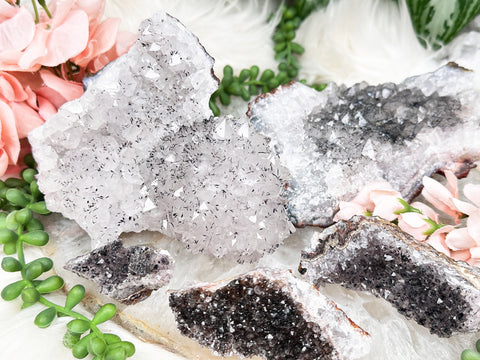
Quartz is a great jewelry option because it looks magnificent and brings healing and balance at the same time. You can even carry it with you in other forms like tumbled stones. Another great way to use this crystal is by introducing it to your meditation, prayer and crystal gridding practices. This stone can also be combined with other crystals to amplify their effects. There’s also an endless amounts of Feng Shui placements you can try out in your home like near the bed for better rest. With all this being said, Quartz crystals are a necessity for your crystal collection and alter. They are also a wonderful gift for the crystal enthusiasts in your life!
If you want to learn more about how to tell the difference between quartz and the other members of its family, check out this blog post!

Quartz in Technology and the Modern World
Quartz, beyond its beauty and significance in jewelry and collectibles, plays a critical role in modern technology. Its unique physical and chemical properties, particularly its piezoelectric properties, make it indispensable in numerous applications that power our daily lives.
Quartz and Piezoelectricity
Quartz crystals are piezoelectric, meaning they can generate an electrical charge when mechanical stress is applied. Conversely, they can vibrate at precise frequencies when an electrical charge is applied. This dual characteristic allows quartz to act as a stable oscillator, making it invaluable in devices that require accurate timekeeping or signal processing.
For instance:
- Watches and Clocks: Quartz crystals are at the heart of quartz watches, where they oscillate at a precise frequency of 32,768 times per second. This frequency is converted into electronic pulses that keep the watch running with unparalleled accuracy.
- Electronics: The piezoelectric property of quartz is utilized in devices like radios, televisions, and smartphones to regulate frequencies and stabilize signals.
- Microprocessors: Quartz crystals are also used in microchips and circuits, ensuring that modern computing devices operate efficiently and reliably.
Quartz in Optics and Telecommunications
Quartz's clarity and optical properties have made it an essential material in advanced optics and telecommunications:
- Fiber Optics: Quartz glass is used in fiber optic cables, allowing high-speed data transmission over long distances with minimal loss.
- Lenses and Lasers: Its transparency and resistance to heat make quartz ideal for lenses in high-precision equipment, including lasers and microscopes.
Industrial Applications
Quartz’s durability and resistance to heat and chemicals also lend it to various industrial uses:
- Glass Manufacturing: High-purity quartz is used to create specialized glass for laboratory equipment, solar panels, and lighting.
- Semiconductors: The semiconductor industry relies on quartz crucibles for growing silicon wafers, a fundamental component of electronic devices.

More About Quartz
Quartz has been around for forever it seems. It was widely known by ancient Greeks who called them krystallos, which is how they got the name crystals. The world quartz comes from the German word ‘quarz’. It has a long history as being used in electronics, and still is to this day which is pretty cool to think about!
This crystal is a 7 on the Mohs hardness scale, making it stronger than most minerals and can even scratch steel. Because of its strength, quartz rarely breaks, but if it does, it is more likely to chip in conchoidal fractures (circular patterned breaks that resemble a seashell).
Quartz Localities: Worldwide... like literally almost anywhere crystals can be found haha.
Chakra: Crown
Quartz Inclusions
Quartz, a versatile and abundant crystal, often grows in harmony with other minerals, resulting in a stunning variety of inclusions. These inclusions, while adding to the crystal's visual appeal, also contribute to its metaphysical properties and uniqueness.
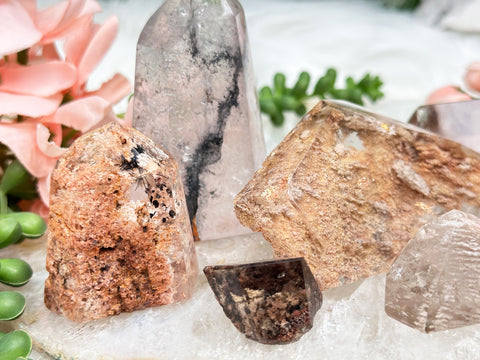
One of the most common inclusions in quartz is rutile. Rutile appears as delicate, golden, or reddish-brown needles or threads within the quartz matrix. These needle-like inclusions create intricate and captivating patterns that are highly sought after by crystal enthusiasts. Rutile-infused quartz is believed to amplify the crystal's energy, making it a potent tool for enhancing one's spiritual journey and personal growth.
Chlorite is another inclusion often found in quartz crystals. It manifests as green, platy or fibrous inclusions that create a lush, mossy appearance within the crystal. Chlorite-infused quartz is associated with healing, detoxification, and cleansing energies. It is believed to facilitate emotional and physical well-being, making it a popular choice for those seeking holistic healing.
Lepidocrocite is a red or crimson mineral inclusion that can give quartz crystals a fiery and passionate appearance. This inclusion is associated with emotional healing, love, and enhancing one's intuition. Lepidocrocite-infused quartz is cherished for its ability to promote self-love and ignite the flames of passion in one's life.

In addition to those, quartz can host an extensive range of other inclusions, including but not limited to goethite, brookite, hematite, tourmaline, chlorite, feldspar, and pyrite. These inclusions contribute to the quartz's overall energy and appearance, making each specimen a unique and valuable addition to the world of crystal healing and metaphysical exploration.
In addition to these inclusions, quartz is known for its remarkable ability to grow alongside and even into other crystals. This growth phenomenon results in captivating formations like quartz with amethyst, citrine, or smoky quartz. These combinations blend the properties of both crystals, creating powerful and harmonious energies.
Quartz's affinity for coexisting with various minerals leads to a rich tapestry of inclusions and formations, each with its own unique beauty and metaphysical significance. Exploring the world of quartz reveals a captivating journey through the wonders of the Earth's crystalline treasures.

Frequently Asked Questions on Quartz
1. What is quartz?
Quartz is a mineral composed of silicon dioxide (SiO₂). It is one of the most abundant minerals on Earth and forms in a hexagonal crystal structure.
2. What are the main types of quartz?
Quartz is classified into:
- Macrocrystalline Quartz: Includes amethyst, citrine, smoky quartz, rose quartz, and rock crystal. Crystals are visible to the naked eye.
- Cryptocrystalline Quartz: Includes chalcedony, agate, jasper, and onyx. Crystals are microscopic and form opaque stones.
3. How is quartz formed?
Quartz forms when silicon and oxygen combine in molten magma, cooling to create crystals. Impurities, heat, and radiation during formation result in various colors and patterns.
4. What makes quartz unique?
Quartz is piezoelectric, meaning it generates an electrical charge under mechanical stress. It is also durable, with a Mohs hardness of 7, making it suitable for jewelry and industrial applications.
5. What are some popular quartz varieties?
- Amethyst: Purple quartz formed by iron impurities and radiation.
- Citrine: Yellow quartz caused by ferric iron.
- Smoky Quartz: Gray to black quartz influenced by natural radiation.
- Rose Quartz: Pink quartz colored by manganese or titanium.
6. What are common uses of quartz?
- Jewelry: Popular for its beauty and durability.
- Technology: Used in watches, clocks, semiconductors, and fiber optics due to its piezoelectric properties.
- Industry: Essential in glassmaking, solar panels, and laboratory equipment.
7. How can I tell quartz apart from similar stones?
- Calcite: Softer (Mohs hardness 3) and forms in rhombohedral shapes.
- Apophyllite: Has a cubic or pyramidal structure and often flakes under heat.
- Topaz: Harder (Mohs hardness 8) and more valuable than quartz.
8. Is quartz rare?
No, quartz is abundant, but some varieties, like natural citrine or ametrine (a mix of amethyst and citrine), are rarer than others.
9. Can quartz be synthetic?
Yes, quartz can be synthesized for industrial and technological use, especially for applications requiring consistent quality and purity.
10. What is quartz's significance in history?
Quartz has been revered for centuries for its mystical and practical properties. Ancient cultures used it for tools, ornaments, and spiritual rituals, believing it held protective and healing powers.